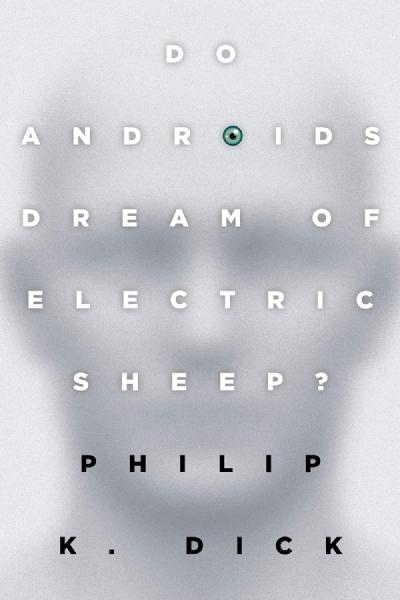
I loved Blade Runner, both the 1982 original and the 2017 sequel. So this book, the one they’re both based on, has been on my list for a long while. I’m very happy I finally got around to it.
On the surface it’s a story about the people left on Earth after World War Terminus. Rick Deckard is a bounty hunter who “retires” outlaw androids, and he’s handed six that have just escaped.
That’s only the backdrop, though. What the book is really about took me a while to put into words after I’d finished it.
Society in the book is built on a sharp divide between the artificial and the organic. Real animals rank above electric ones, and humans rank above androids. Everyone seems to agree the line is obvious.
Except it isn’t. Telling a human from an android takes a specialized test with complicated equipment. And that test has to be updated again and again to keep up with each new model.
If the difference really were that sharp, why would you need a machine to find it?
The test, Voigt-Kampff, measures empathy. That’s what humans have decided separates them from androids, so the line they defend by origin is actually drawn by empathy.
And empathy doesn’t sort people the way they’d like it to. The book has cruel scenes where androids and humans alike show none. The longer you read, the muddier the division gets.
I love how quietly Dick does this. He never stops to spell it out. He just lets the characters draw the line in the wrong place and lets you notice.
Then there’s the mood organ, another fascinating device. You dial a number and the machine sets your feelings for you.
Deckard’s wife, Iran, schedules despair twice a month. She thinks it’s the honest response to the world they live in. So she’s chosen to feel hopeless, on a timetable.
What is a chosen feeling worth? I still don’t know. But it confounds the human–android divide even further: here are the “real” humans running their emotions like machines.
(That said, I could see a use for mood 594, “pleased acknowledgment of husband’s superior wisdom in all matters”.)
I picked this up as the book behind two movies I love. It turned out to be much more than that, and I’m still chewing on exactly what questions Philip K. Dick raised here.
If you’ve only seen the films, read the book. It’s stranger than they are, and it asks more of you.
→ Get Do Androids Dream of Electric Sheep? now!ad
My highlights
Her dark, pert face showed satisfaction, as if she had achieved something of worth. “So I put it on my schedule for twice a month; I think that’s a reasonable amount of time to feel hopeless about everything, about staying here on Earth after everybody who’s smart has emigrated, don’t you think?”
Iran shut off the TV set. “Okay, I give up; I’ll dial. Anything you want me to be; ecstatic sexual bliss—I feel so bad I’ll even endure that. What the hell. What difference does it make?” “I’ll dial for both of us,” Rick said, and led her back into the bedroom. There, at her console, he dialed 594: pleased acknowledgment of husband’s superior wisdom in all matters.
Nothing could be more impolite. To say, “Is your sheep genuine?” would be a worse breach of manners than to inquire whether a citizen’s teeth, hair, or internal organs would test out authentic.
The legacy of World War Terminus had diminished in potency; those who could not survive the dust had passed into oblivion years ago, and the dust, weaker now and confronting the strong survivors, only deranged minds and genetic properties.
In addition, no one today remembered why the war had come about or who, if anyone, had won.
Local law prohibited the time-reversal faculty by which the dead returned to life; they had spelled it out to him during his sixteenth year. […] Without his parents’ consent they—the killers—had bombarded the unique nodule which had formed in his brain, had attacked it with radioactive cobalt, and this had plunged him into a different world, one whose existence he had never suspected.
In Mercerism, an absolute evil plucked at the threadbare cloak of the tottering, ascending old man, but it was never clear who or what this evil presence was. A Mercerite sensed evil without understanding it. Put another way, a Mercerite was free to locate the nebulous presence of The Killers wherever he saw fit.
The tyranny of an object, he thought. It doesn’t know I exist. Like the androids, it had no ability to appreciate the existence of another.
“This cat,” Sloat said finally, “isn’t false. I knew sometime this would happen. And it’s dead.” He stared down at the corpse of the cat. And cursed again.
Damn her, he said to himself. What good does it do, my risking my life? She doesn’t care whether we own an ostrich or not; nothing penetrates. […] Most androids I’ve known have more vitality and desire to live than my wife. She has nothing to give me.
Some female androids seemed to him pretty; he had found himself physically attracted by several, and it was an odd sensation, knowing intellectually that they were machines, but emotionally reacting anyhow.
“An android,” he said, “doesn’t care what happens to another android. That’s one of the indications we look for.” “Then,” Miss Luft said, “you must be an android.” That stopped him; he stared at her.
All of them, Isidore thought; they’re all strange. He sensed it without being able to finger it. As if a peculiar and malign abstractness pervaded their mental processes.
“You will be required to do wrong no matter where you go. It is the basic condition of life, to be required to violate your own identity. At some time, every creature which lives must do so. It is the ultimate shadow, the defeat of creation; this is the curse at work, the curse that feeds on all life. Everywhere in the universe.”
Do androids dream? Rick asked himself. Evidently; that’s why they occasionally kill their employers and flee here. A better life, without servitude.
Rachael said, “Do you know what the lifespan of a humanoid robot such as myself is? I’ve been in existence two years. How long do you calculate I have?” After a hesitation he said, “About two more years.” “They never could solve that problem. I mean cell replacement. Perpetual or anyhow semi-perpetual renewal. Well, so it goes.”
This is my end, he said to himself. As a bounty hunter. After the Batys there won’t be any more. Not after this, tonight.
Beside him in the darkness the coal of her cigarette glowed like the rump of a complacent lightning bug: a steady, unwavering index of Rachael Rosen’s achievement. Her victory over him.
“Why couldn’t it get by on four? Cut four off and see.” Impulsively opening her purse, she produced a pair of clean, sharp cuticle scissors, which she passed to Pris. A weird terror struck at J. R. Isidore.
If I had killed you last night, my goat would be alive now. There’s where I made the wrong decision. Yes, he thought; it can all be traced back to that and to my going to bed with you. Anyhow, you were correct about one thing; it did change me. But not in the way you predicted. A much worse way, he decided.
If Rick were here, she thought, he’d get me to dial 3 and that way I’d find myself wanting to dial something important, ebullient joy or if not that then possibly an 888, the desire to watch TV no matter what’s on it.