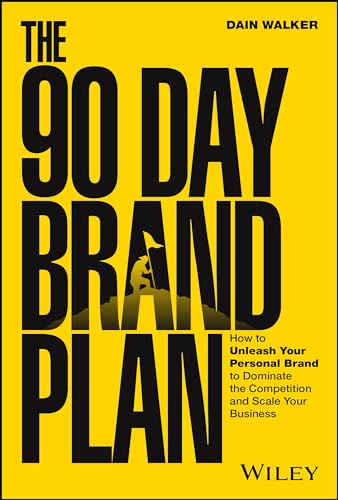
I read a fair amount about productivity, but that is not what I wanted from this book. I came to it for the personal branding, expecting a few tactics I could steal and not much else. What I got instead was an approach I kept thinking about for weeks after, which is not how these books usually go for me.
Dain Walker builds everything around his Campfire-to-Empire Framework. Your content is the campfire, you keep feeding it, and over time people wander out of the wilderness toward the light. I expected to roll my eyes at the extended metaphor. Instead it gave me a way to think about the whole thing that I keep coming back to.
The idea underneath it all reframed personal branding for me. Walker says branding is not about projecting who you are now, but about actualizing your future self into the present. You decide who you want to become and act like that person today. That is a real answer to imposter syndrome, and it turns branding into a process of growth instead of a static image you have to defend.
The other half of that is staying a student. Walker keeps looking back at his own content from a month ago to check whether he has improved, and treats it as a bad sign if he hasn’t. I do the same with my tech work. If I’m not a little ashamed of what I built a year ago, I haven’t grown, and that prospect scares me. Seeing him build that into a habit made it feel less like anxiety and more like a method.
He is relentless about just starting. Don’t plan, don’t polish — post it and learn. You get good by iterating in public, not by preparing to be good. He extends the usual “post often to feed the algorithm” advice with something better: posting daily shows up as curiosity, and 365 posts a year takes the pressure off any single one.
The book is heavy on hustle culture, which I normally don’t care too much for, but here it works. You don’t have to swallow his whole approach to get value, but it is a fair reminder that this is hard, consistent work.
Where I pushed back: Walker is almost allergic to selling. He treats “come to my event” as hard selling. His formative Gary Vee moment has colored this too much, and I think he leaves money on the table by never asking. The trick, as in Gary Vee’s Jab, Jab, Jab, Right Hook, is asking well.
His trust model, that people must trust the WHO, WHAT, and HOW of you, lines up neatly with Building a StoryBrand. His MEAT method for products is too thin; read $100M Offers instead.
Weeks after finishing it I still catch myself thinking in campfires and future selves, which is the real test for me. Most books in this space give me a few notes and then fade. This one changed how I actually think, and that is rare enough that I’d hand it to anyone serious about building a personal brand.
→ Get The 90 Day Brand Plan now!ad
My highlights
My personal brand was the reason I was invited to share stages with life and business strategist Tony Robbins, author and business consultant Seth Godin, public speaker and educator Chris Do, entrepreneur Lewis Howes, sporting legend Tom Brady, business mogul Simon Beard, and businessman Tom Bilyeu.
I crafted a personal brand so that I could serve up opportunities for myself on a golden platter—not knowing what they would be on the outlook, but knowing they would arrive if I got my face out of obscurity and into the limelight.
[H]uman beings are wired to connect to people, not objects. And that’s a big reason for the surge of influencers in today’s market.
Whether we’re aware of it or not, we all have a personal brand. […] My question to you, however, is whether you’re using it to its full advantage to get more opportunities in life like it has for me.
If your 90‐day game plan doesn’t succeed, it doesn’t mean that you won’t ever succeed—it just means you need to adapt and change your approach. It’s better to discover your idea doesn’t work in 90 days than waiting a few years before even giving it a go.
The dirty thief of success is procrastination, which leads to never trying in the first place.
The 90‐day brand plan is about attacking the market with everything you’ve got and stopping at nothing to make it happen on your own terms.
The moment you take full responsibility for not being in full pursuit of going for your desired goal, you take back control of your story and the ownership over your goal.
[Y]ou’re solely responsible for not just your failures but also your success. Nobody is going to save you. Nobody is going to do it for you. Throwing money at the problem won’t fix the root cause. It’s purely your duty, your obligation, and your quest to do this for yourself.
You must approach your personal branding journey like you’re studying and not mastering. Because you are. Until you’re a master, you’re a student. And to remain a master, guess what? You still have to be a student.
To build your personal brand is to actualize your future self into the present. By thinking about whom you wish to become in the future and embodying that person now, you’re priming yourself to start acting accordance to your goals.
If you think like a student, you won’t feel the pressure to perform like a master. When you do meet masters, you’ll be surprised that the majority of them still act and behave like students, always testing new concepts, always learning, always adapting to what’s happening with new platforms, and adjusting on the fly.
Your content, whatever it is, is a campfire. Each piece of content is a log in the fire to keep your personal brand alive and burning. Over time your campfire will start drawing a crowd out of the wilderness.
How could you possibly know where to choose if you’ve never even scouted the area before? I suggest you scout the terrain a little to get acquainted with what others are doing in your space.
I like to think of it like this: every day we have 24 one‐hour tokens to invest. How we choose to invest each token maps out our future lives. I like to call these tokens fuel tokens because they create and fuel your campfire’s success. You’re either wasting your fuel or using it. If you want to accomplish great things, you must dedicate as many fuel tokens as possible toward your cause—every day.
I suggest breaking content creation into smaller chunks of each day rather than one giant chunk every week.
Growing your brand is not earned in a blaze of glory; it’s earned in sparks and glowing embers. Each action, each post, each engagement is a tiny spark. If we lack consistency, our fire will never combust; we must constantly apply heat for our tribe to grow.
Fear is nonnegotiable. […] Fear is your compass pointing to the things that lay outside your comfort zone that you inherently know you must do.
Modeling others in the early stages helped me gain momentum and altitude. By accumulating and duplicating what worked wonderfully for others, I was able to develop myself into what I do now as a personal brand. Through modeling others, I found myself, one piece at a time.
Building a personal brand isn’t about blending in, looking like everyone else. You want to be different from everyone else—drastically different. You don’t want to be ordinary; you want to be extraordinary.
I scroll through my feed of the previous 30 days to see if I can detect transformation and improvement in my delivery, style, and technique. If I don’t, I push myself to explore and experiment with new angles.
[D]on’t worry if you post something and don’t feel great about it. Post it anyway and move on. The point is to not overthink or overengineer each piece of content. It’s more important to your tribe that you keep the flames red‐hot by consistently throwing logs on your campfire.
[I]f you let the fire subside by not frequently adding more logs, it won’t just deter your tribe from checking your page—it also sends a powerful negative message: that content is not your priority. In other words: you don’t have anything to offer.
The goal is to not just haphazardly post about anything and everything. Part of establishing your personal brand is to clarify for your audience what your brand actually is—what you actually think and feel and believe and do. Keep consistently throwing content out there, and keep it on point.
In order to maximize the growth and reach of your page, you’ll want to ensure that you package your content in various quantities—so all visitors can partake and leave satisfied.
Your five key themes are the five primary things you will talk about for your first 90 days.
Sometimes we have to do things we’re unsure about to unearth the things we’re completely sure about.
I recommend writing down 40 ideas for each theme. […] Once you’ve listed 40 ideas for each of the five themes, for a total of 200 ideas, then review all your ideas, one theme at a time, to identify which ideas speak to you the most.
Everything I make for my content is engineered to take the viewer on a journey and give them a payoff at the end. This engineering involves separately taking each theme and filtering it through all four approaches of what I call the HOLD method: hook, own, love, and direct.
The entire concept of building a personal brand is understanding that you’re sharing your expertise, your value, and your credibility. But more than anything, building a personal brand is all about serving your tribe; it’s about your ability to lead others—not your ability to promote yourself.
Something as simple as “come to my event” or “listen to my podcast” can be perceived by your visitor as hard selling.
To earn your tribe members’ trust enough for them to consider buying your goods or services, you must convince them of three essential aspects of your brand: they need to trust the WHO, the WHAT, and the HOW of you. In other words, they need to trust who you are, what you offer (and what of it is relevant to them), and how you will effectively provide it to them.
Money can’t incubate trust, but trust can definitely incubate money. Trust incubates opportunities, trust incubates enquiries, and trust can incubate referrals. Your personal brand is an incubator of trust; the more trust you can build with your tribe, the more likely they’ll be willing to make transactions with you.
With every log you throw on the campfire, ask yourself, “Will this help build trust in my tribe?” If the answer is yes, then power on!
Appearing like too much of an expert and too credible can make your brand appear irrelevant to them. This is why identifying your tribe is essential.
You can earn a tribe member’s trust by demonstrating that you are like them: of the same mind, of the same circumstance—of one accord. It’s okay to be a few leaps beyond them or a few leaps behind, but the more you demonstrate how well you understand the world they’re in and the problems they face, the more likely they will trust what you have to say.
[Y]ou’ll want to clearly demonstrate that transacting with you will produce their desired outcome. You can do this by clarifying for them the entire path from A (the moment they sign the deal) to Z (the moment their desired outcome is complete).
As your content campfire grows, and your tribe grows, your campfire will develop into a village of dedicated fans (what I’ve been calling a tribe)—some of whom will actively seek ways to work with you beyond the means of your content.
You want to clarify for yourself, and consistently and clearly broadcast to others, the answers to three questions: What makes you a credible figure of authority? What makes you relevant to your tribe? What makes you reliable?
Something I focus a lot of energy on with my tribe is being as relevant as possible to them by reminding them I’m human, that I feel and go through all the same things that they do.
[T]he first step in building a reputation is to clarify this for yourself. What do you want to be known for? And how does that desire lead to your product and service offering? And how can you ensure you’re absolutely unambiguous?
I don’t initially mention all these services upfront, which we proudly offer, because I don’t want my brand to be seen as “the one‐stop shop,” which can, in my opinion, dilute the weight of your core offering by casting too wide of a net.
I liken the process of developing a product or offering to a chef coming up with their own signature dish. Even if it’s a staple like a burger, the ingredients they use might be different—or they might aim for unexpected flavor or unique presentation.
[M]y initial year and set of services made me millions of dollars. A product I would now label as inferior, that I would label as amateur cooking, made me a lot of money
The plain truth is there will never be a time when 100% of your tribe is so engaged that they will all purchase your offering. In my experience, only 1% of that tribe will be willing to buy what you’re cooking at any one time.
As surprising as it sounds, many of the 99% of the tribe who never buy from you promote your campfire to the 1% who will buy from you.
If you break your momentum, you sever the bonds that have been forged with the 99% who are marketing your offering.
It’s up to you to make sure that your personal brand is available for all members of your tribe, and you want it to be known that you have brackets of entry.
Members of your tribe who don’t pay you directly can pay you indirectly by boosting the reach of your content and personal brand to others who don’t yet know you exist.
In many ways, your taste testers and appetizers should reveal the complexity of solving their problem. This might make them realize that attempting to solve their problem themselves could end up being the wrong decision: taking longer, costing more, and producing a lower‐quality solution than if they pay you to do it—either with them or for them.
Dessert products are more than side dishes; they’re lateral products that solve other problems that your main course offering doesn’t include. The reason I label these dessert products and not additional main courses is because, based on the way I heavily pitched my main courses only, clients didn’t come to me to solve these problems, generally speaking.
I also suggest you hold off developing your dessert options until you’ve mastered selling your main course and side dishes. But even before you’re ready, you’ll want to identify these hardcore tribe members as soon as possible.
Just keep in mind that all your product suites must orbit your main course. Everything else is either a lead‐in or a supplement to your main course.
Partnerships are any business relationships you develop with companies and personal brands. As such, they’re access roads between you and entities who offer services that you don’t.
A simple tool I’ve exploited to fast‐track networking is a personal branding pitch deck. Think of it as an ever‐evolving promotional text and visual‐based document that is the distillation of everything you do and all that you’ve achieved. [… W]henever we want to extend an invitation to create a new access road between myself and another campfire or empire, my marketing team simply sends this document.
Every day, find at least one person who has direct access to a network you want to get in front of and find ways to give them value.
If you want this to succeed, you have to study relentlessly and actually become the type of person you need to become in order to become successful.