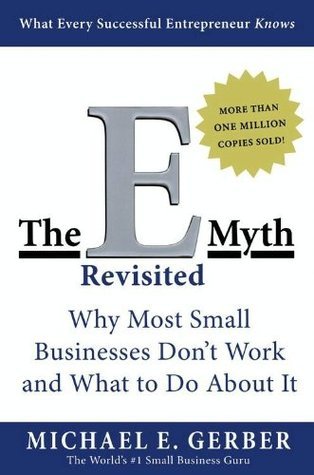
Most small businesses fail because their founders wanted to create a better job for themselves, not to build something independent. I didn’t fully grasp this until I read The E-Myth Revisited, and the insight explained so many challenges I’ve faced in my own ventures.
Michael E. Gerber’s central argument is straightforward: you need to design your business systematically, as if you were creating a prototype for a franchise. This means building systems and processes so the business runs without your constant involvement. The goal is to work on the business, not in it, and to avoid what Gerber calls the Fatal Assumption: that because you understand the technical work of a business, you understand a business doing such work.
The most striking idea for me was the three roles: the Technician, the Manager, and the Entrepreneur. Each role has different needs and interests. Gerber illustrates this with his Skinny Guy and Fat Guy example, showing how most people already shift between completely different personas depending on context. Understanding these roles helps you identify your strengths and weaknesses, and build a more balanced team.
Gerber also categorizes businesses into three stages: Infancy, Adolescence, and Maturity. Much like the categorization prescribed by The Four Steps to the Epiphany and The First 90 Days, this framework helps you reflect on where your business is and what challenges to expect. One interesting twist is that companies don’t naturally progress to Maturity. They force themselves there by thinking and acting as if they are already there.
The book is practical and full of ideas you’ll want to apply immediately. There is, though, a fair amount of woo-woo spiritual language sprinkled throughout, which felt out of place in an otherwise grounded business book. If you’re allergic to that sort of thing, you’ll find yourself skimming a few sections.
The framework Gerber presents is clear, systematic, and applicable. I finished with a sharper understanding of why so many businesses struggle and what to do about it. More than anything, I now see how building sustainable ventures requires thinking like a franchise owner from day one, even if you never plan to franchise.
→ Get The E-Myth Revisited now!ad
My highlights
Contrary to popular belief, my experience has shown me that the people who are exceptionally good in business aren’t so because of what they know but because of their insatiable need to know more. The problem with most failing businesses I’ve encountered is not that their owners don’t know enough about finance, marketing, management, and operations—they don’t, but those things are easy enough to learn—but that they spend their time and energy defending what they think they know.
[Y]our business is nothing more than a distinct reflection of who you are. If your thinking is sloppy, your business will be sloppy. If you are disorganized, your business will be disorganized. If you are greedy, your employees will be greedy, giving you less and less of themselves and always asking for more. If your information about what needs to be done in your business is limited, your business will reflect that limitation.
The excitement of cutting the cord became your constant companion. The thought of independence followed you everywhere. The idea of being your own boss, doing your own thing, singing your own song, became obsessively irresistible.
That Fatal Assumption is: if you understand the technical work of a business, you understand a business that does that technical work.
The problem is that everybody who goes into business is actually three-people-in-one: The Entrepreneur, The Manager, and The Technician. And the problem is compounded by the fact that while each of these personalities wants to be the boss, none of them wants to have a boss. So they start a business together in order to get rid of the boss. And the conflict begins.
The Skinny Guy and The Fat Guy are two totally different personalities, with different needs, different interests, and different lifestyles.
To The Entrepreneur, most people are problems that get in the way of the dream.
Without The Manager, there could be no business, no society. Without The Entrepreneur, there would be no innovation. It is the tension between The Entrepreneur’s vision and The Manager’s pragmatism that creates the synthesis from which all great works are born.
To The Manager, then, The Technician becomes a problem to be managed. To The Technician, The Manager becomes a meddler to be avoided. To both of them, The Entrepreneur is the one who got them into trouble in the first place!
It’s easy to spot a business in Infancy—the owner and the business are one and the same thing. If you removed the owner from an Infancy business, there would be no business left. It would disappear! In Infancy, you are the business.
Infancy ends when the owner realizes that the business cannot continue to run the way it has been; that, in order for it to survive, it will have to change. When that happens—when the reality sinks in—most business failures occur. When that happens, most of The Technicians lock their doors behind them and walk away. The rest go on to Adolescence.
If your business depends on you, you don’t own a business—you have a job. And it’s the worst job in the world because you’re working for a lunatic!
You can’t ignore the financial accountabilities, the marketing accountabilities, the sales and administrative accountabilities. You can’t ignore your future employees’ need for leadership, for purpose, for responsible management, for effective communication, for something more than just a job in which their sole purpose is to support you doing your job.
It’s called Management by Abdication rather than by Delegation.
The Technician’s boundary is determined by how much he can do himself. The Manager’s is defined by how many technicians he can supervise effectively or how many subordinate managers he can organize into a productive effort. The Entrepreneur’s boundary is a function of how many managers he can engage in pursuit of his vision.
And as the business grows beyond the owner’s Comfort Zone—as the tailspin accelerates—there are only three courses of action to be taken, only three ways the business can turn. It can return to Infancy. It can go for broke. Or it can hang on for dear life.
You don’t own a business—you own a job! What’s more, it’s the worst job in the world! You can’t close it when you want to, because if it’s closed you don’t get paid. You can’t leave it when you want to, because when you leave there’s nobody there to do the work. You can’t sell it when you want to, because who wants to buy a job?
A Mature company is founded on a broader perspective, an entrepreneurial perspective, a more intelligent point of view. About building a business that works not because of you but without you.
Maturity is not an inevitable result of the first two phases. It is not the end product of a serial process, beginning with Infancy and moving through Adolescence. No, companies like McDonald’s, Federal Express, and Disney didn’t end up as Mature companies. They started out that way! The people who started them had a totally different perspective about what a business is and why it works.
Lacking the grander scale and visionary guidance manifest in the Entrepreneurial Model, The Technician is left to construct a model each step of the way. But the only model from which to construct it is the model of past experience, the model of work. Exactly the opposite of what he needs if the business is to free him of the work he’s grown accustomed to doing.
[T]he Entrepreneurial Model has less to do with what’s done in a business and more to do with how it’s done. The commodity isn’t what’s important—the way it’s delivered is.
[T]he Entrepreneurial Model does not start with a picture of the business to be created but of the customer for whom the business is to be created. It understands that without a clear picture of that customer, no business can succeed.
In short, for this business model of ours to work, it must be balanced and inclusive so that The Entrepreneur, The Manager, and The Technician all find their natural place within it, so that they all find the right work to do.
[The] Business Format Franchise is built on the belief that the true product of a business is not what it sells but how it sells it.
The true product of a business is the business itself.
It is in the Franchise Prototype that every successful franchisor builds his future. It is in the Franchise Prototype that every extraordinary franchisor plants the seeds of his fortune. And it is in the Franchise Prototype that you can find the model you need to make your business work.
Over the course of one year, Business Format Franchises have reported a success rate of 95 percent in contrast to the 50-plus-percent failure rate of new independently owned businesses. Where 80 percent of all businesses fail in the first five years, 75 percent of all Business Format Franchises succeed!
The Prototype acts as a buffer between hypothesis and action. Putting ideas to the test in the real world rather than the world of competing ideas. The only criterion of value becomes the answer to the ultimate question: “Does it work?”
The system isn’t something you bring to the business. It’s something you derive from the process of building the business.
To The Entrepreneur, the Franchise Prototype is the medium through which his vision takes form in the real world. To The Manager, the Franchise Prototype provides the order, the predictability, the system so important to his life. To The Technician, the Prototype is a place in which he is free to do the things he loves to do—technical work.
Pretend that the business you own—or want to own—is the prototype, or will be the prototype, for 5,000 more just like it. That your business is going to serve as the model for 5,000 more just like it. Not almost like it, but just like it. Perfect replicates. Clones.
The question you need to keep asking yourself is: How can I give my customer the results he wants systematically rather than personally? Put another way: How can I create a business whose results are systems-dependent rather than people-dependent? Systems-dependent rather than expert-dependent.
[W]hen you intentionally build your business around the skills of ordinary people, you will be forced to ask the difficult questions about how to produce a result without the extraordinary ones. You will be forced to find a system that leverages your ordinary people to the point where they can produce extraordinary results over and over again. You will be forced to invent innovative system solutions to the people problems that have plagued small businesses (and big businesses as well!) since the beginning of time. You will be forced to build a business that works.
A business that looks orderly says to your customer that he can trust in the result delivered and assures your people that they can trust in their future with you.
What you do in your model is not nearly as important as doing what you do the same way, each and every time.
Your Prototype must be packaged as carefully as any box of cereal.
Where the business is the product, how the business interacts with the consumer is more important than what it sells.
Orchestration is the elimination of discretion, or choice, at the operating level of your business.
Your Business Development Program is the step-by-step process through which you convert your existing business—or the one you’re about to create—into a perfectly organized model for thousands more just like it. Your Business Development Program is the vehicle through which you can create your Franchise Prototype.
What do I value most? What kind of life do I want? What do I want my life to look like, to feel like? Who do I wish to be? Your Primary Aim is the answer to all these questions.
You’re telling them the story of your life. How would you like that story to go? That’s your Primary Aim.
Your Strategic Objective is a very clear statement of what your business has to ultimately do for you to achieve your Primary Aim.
An Opportunity Worth Pursuing is a business that can fulfill the financial standards you’ve created for your Primary Aim and your Strategic Objective.
The commodity is the thing your customer actually walks out with in his hand. The product is what your customer feels as he walks out of your business. What he feels about your business, not what he feels about the commodity. Understanding the difference between the two is what creating a great business is all about.
A Position Contract (as we call it at E-Myth Worldwide) is a summary of the results to be achieved by each position in the company, the work the occupant of that position is accountable for, a list of standards by which the results are to be evaluated, and a line for the signature of the person who agrees to fulfill those accountabilities.
As Murray goes to work in the position of Salesperson, he also goes to work on the position of Salesperson as Vice-President/Marketing. As Jack goes to work in the position of Production Person, he also goes to work on the position of Production Person as Vice-President/Operations. In other words, Murray and Jack start building their business by looking at each position in the business as though it were a Franchise Prototype of its own.
Only when the Sales Operations Manual is complete does Murray run an ad for a salesperson. But not for someone with sales experience. Not a Master Technician. But a novice. A beginner. An Apprentice. Someone eager to learn how to do it right. Someone willing to learn what Murray has spent so much time and energy discovering.
At that moment, at that exact instant, Murray moves up to the position of Sales Manager and begins the process of Business Development all over again. Because at that moment, Murray has taken the most important step in freeing himself from the Tactical Work of his business. Murray has replaced himself with a system that works in the hands of a person who wants to work it.
The game has to be real. You have to mean it. The game is a measure of you. How you act in the game establishes how you will be regarded by the other players.
“Delegating your accountabilities is abdication.
So when your customer says, “I want to think about it,” don’t you believe him. He’s not going to think about it. He doesn’t know how. He’s already done all the “thinking” he’s going to do—he either wants it or not. What your customer is really saying is one of two things: he is either emotionally incapable of saying no for fear of how you might react if he told you the truth, or you haven’t provided him with the “food” his Unconscious Mind craves.
So the famous dictum that says, “Find a need and fill it,” is inaccurate. It should say, “Find a perceived need and fill it.” Because if your customer doesn’t perceive he needs something, he doesn’t, even if he actually does.
I have seen more often than not that the only definition of ‘good common sense’ is ‘my opinion.’
The Power Point Selling System is composed of two parts: Structure and Substance. Structure is what you do. Substance is how you do it.
Most salespeople think that selling is “closing.” It isn’t. Selling is opening.
But believe me, whether you’re selling sheets and pillow cases, computers, swimming pools, flowers and fertilizer, canaries, puppies, or Quonset huts, the Power Point Selling Process will work. How do I know that? Because it already has!
Meaning, it seems to me, is the product of caring, not vice versa. What we care about we value.
Your Comfort Zone has been the curtain you have placed in front of your face and through which you view the world. Your Comfort Zone has been the tight little cozy planet on which you have lived, knowing all the places to hide because it’s so small.
This book is not simply a prescription for success; it’s a call to arms. But this call to arms is not a call to do battle. It’s a call to learning. How to feel, think, and act differently and more productively, more humanly than our existing skills and understanding allow.