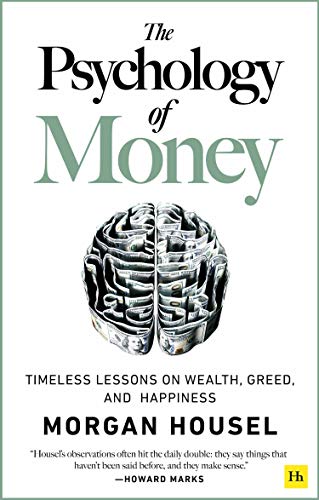
Money is one of the few areas where being “reasonable” beats being smart. That’s the quiet but persistent thought I walked away with after reading The Psychology of Money, and it’s why the book stuck with me longer than most personal finance writing.
This isn’t a book about how to optimize returns. It’s about how people actually behave when money is involved, and why that behavior matters more than spreadsheets. Housel treats personal finance less like physics and more like anthropology: a messy mix of incentives, emotions, history, and individual quirks. The title isn’t clever, but precise.
The idea that hit hardest for me was the sheer dominance of compounding. Not as a mathematical curiosity, but as a behavioral one. You don’t need brilliance or perfect timing. You need durability. Avoid catastrophic mistakes, protect yourself against ruin, and let time do its quiet work. That framing subtly shifts the goal from “be right” to “stay in the game,” which feels both more realistic and more humane.
I also appreciated the book’s refusal to prescribe a single “correct” way to spend or invest. Instead, it keeps circling back to values. Money, Housel argues, is a tool for controlling your time and aligning your life with what you actually care about, not what looks impressive on paper. That resonated strongly with me, especially after reading 12 Rules for Life, where the emphasis is similarly on personal responsibility and value alignment rather than external metrics of success.
The frequent references to Daniel Kahneman were another signal that this book was operating on the right level. Like Thinking, Fast and Slow, it treats human irrationality not as a flaw to eliminate, but as a fact to design around. We’re bad at intuitively understanding risk, probability, and long time horizons. That leads to fragile mental models and fragile decisions. Simply recognizing those biases, as I was reminded again after The Skeptic’s Guide to the Universe, is already a competitive advantage.
If there’s a limitation, it’s that readers looking for concrete tactics or advanced investing strategies may feel underwhelmed. This book won’t tell you what to buy next. It tells you how not to sabotage yourself over decades. That’s less exciting, but far more useful.
This is a book for people who want a healthier relationship with money, not just higher returns. I found myself not just nodding along, but thinking about how to pass these ideas on to my kids. That alone says a lot.
→ Get The Psychology of Money now!ad
My highlights
The premise of this book is that doing well with money has a little to do with how smart you are and a lot to do with how you behave. And behavior is hard to teach, even to really smart people.
[F]inancial success is not a hard science. It’s a soft skill, where how you behave is more important than what you know.
The aim of this book is to use short stories to convince you that soft skills are more important than the technical side of money.
[W]e think about and are taught about money in ways that are too much like physics (with rules and laws) and not enough like psychology (with emotions and nuance).
To grasp why people bury themselves in debt you don’t need to study interest rates; you need to study the history of greed, insecurity, and optimism. To get why investors sell out at the bottom of a bear market you don’t need to study the math of expected future returns; you need to think about the agony of looking at your family and wondering if your investments are imperiling their future.
People from different generations, raised by different parents who earned different incomes and held different values, in different parts of the world, born into different economies, experiencing different job markets with different incentives and different degrees of luck, learn very different lessons.
Your personal experiences with money make up maybe 0.00000001% of what’s happened in the world, but maybe 80% of how you think the world works.
Spreadsheets can model the historic frequency of big stock market declines. But they can’t model the feeling of coming home, looking at your kids, and wondering if you’ve made a mistake that will impact their lives.
Every decision people make with money is justified by taking the information they have at the moment and plugging it into their unique mental model of how the world works.
Those buying $400 in lottery tickets are by and large the same people who say they couldn’t come up with $400 in an emergency. They are blowing their safety nets on something with a one-in-millions chance of hitting it big.
When judging others, attributing success to luck makes you look jealous and mean, even if we know it exists. And when judging yourself, attributing success to luck can be too demoralizing to accept.
It’s possible to statistically measure whether some decisions were wise. But in the real world, day to day, we simply don’t. It’s too hard. We prefer simple stories, which are easy but often devilishly misleading.
The difficulty in identifying what is luck, what is skill, and what is risk is one of the biggest problems we face when trying to learn about the best way to manage money.
Some people are born into families that encourage education; others are against it. Some are born into flourishing economies encouraging of entrepreneurship; others are born into war and destitution. I want you to be successful, and I want you to earn it. But realize that not all success is due to hard work, and not all poverty is due to laziness. Keep this in mind when judging people, including yourself.
Failure can be a lousy teacher, because it seduces smart people into thinking their decisions were terrible when sometimes they just reflect the unforgiving realities of risk.
There is no reason to risk what you have and need for what you don’t have and don’t need.
The hardest financial skill is getting the goalpost to stop moving.
Happiness, as it’s said, is just results minus expectations.
Reputation is invaluable. Freedom and independence are invaluable. Family and friends are invaluable. Being loved by those who you want to love you is invaluable. Happiness is invaluable. And your best shot at keeping these things is knowing when it’s time to stop taking risks that might harm them. Knowing when you have enough.
Effectively all of Warren Buffett’s financial success can be tied to the financial base he built in his pubescent years and the longevity he maintained in his geriatric years.
There are books on economic cycles, trading strategies, and sector bets. But the most powerful and important book should be called Shut Up And Wait. It’s just one page with a long-term chart of economic growth.
Getting money is one thing. Keeping it is another.
Getting money requires taking risks, being optimistic, and putting yourself out there. But keeping money requires the opposite of taking risk. It requires humility, and fear that what you’ve made can be taken away from you just as fast.
More than I want big returns, I want to be financially unbreakable. And if I’m unbreakable I actually think I’ll get the biggest returns, because I’ll be able to stick around long enough for compounding to work wonders.
Planning is important, but the most important part of every plan is to plan on the plan not going according to plan.
Room for error—often called margin of safety—is one of the most underappreciated forces in finance.
A mindset that can be paranoid and optimistic at the same time is hard to maintain, because seeing things as black or white takes less effort than accepting nuance. But you need short-term paranoia to keep you alive long enough to exploit long-term optimism.
Napoleon’s definition of a military genius was, “The man who can do the average thing when all those around him are going crazy.” It’s the same in investing.
The Chris Rock I see on TV is hilarious, flawless. The Chris Rock that performs in dozens of small clubs each year is just OK.
When we pay special attention to a role model’s successes we overlook that their gains came from a small percent of their actions. That makes our own failures, losses, and setbacks feel like we’re doing something wrong.
The highest form of wealth is the ability to wake up every morning and say, “I can do whatever I want today.”
The ability to do what you want, when you want, with who you want, for as long as you want, is priceless. It is the highest dividend money pays.
Having a strong sense of controlling one’s life is a more dependable predictor of positive feelings of wellbeing than any of the objective conditions of life we have considered.
[D]oing something you love on a schedule you can’t control can feel the same as doing something you hate. There is a name for this feeling. Psychologists call it reactance.
There is a paradox here: people tend to want wealth to signal to others that they should be liked and admired. But in reality those other people often bypass admiring you, not because they don’t think wealth is admirable, but because they use your wealth as a benchmark for their own desire to be liked and admired.
If respect and admiration are your goal, be careful how you seek it. Humility, kindness, and empathy will bring you more respect than horsepower ever will.
Someone driving a $100,000 car might be wealthy. But the only data point you have about their wealth is that they have $100,000 less than they did before they bought the car (or $100,000 more in debt). That’s all you know about them.
When most people say they want to be a millionaire, what they might actually mean is “I’d like to spend a million dollars.” And that is literally the opposite of being a millionaire.
Wealth is an option not yet taken to buy something later. Its value lies in offering you options, flexibility, and growth to one day purchase more stuff than you could right now.
Exercise is like being rich. You think, “I did the work and I now deserve to treat myself to a big meal.” Wealth is turning down that treat meal and actually burning net calories. It’s hard, and requires self-control. But it creates a gap between what you could do and what you choose to do that accrues to you over time.
After he died, Ronald Read became many people’s financial role model. He was lionized in the media and cherished on social media. But he was nobody’s financial role model while he was living because every penny of his wealth was hidden, even to those who knew him.
The first idea—simple, but easy to overlook—is that building wealth has little to do with your income or investment returns, and lots to do with your savings rate.
Wealth is just the accumulated leftovers after you spend what you take in.
[S]ince you can build wealth without a high income, but have no chance of building wealth without a high savings rate, it’s clear which one matters more.
You’re not a spreadsheet. You’re a person. A screwed up, emotional person.
The historical odds of making money in U.S. markets are 50/50 over one-day periods, 68% in one-year periods, 88% in 10-year periods, and (so far) 100% in 20-year periods.
Harvard psychologist Max Bazerman once showed that when analyzing other people’s home renovation plans, most people estimate the project will run between 25% and 50% over budget. But when it comes to their own projects, people estimate that renovations will be completed on time and at budget.
For my own investments, which I’ll describe more in chapter 20, I assume the future returns I’ll earn in my lifetime will be ⅓ lower than the historic average.
The odds are in your favor when playing Russian roulette. But the downside is not worth the potential upside. There is no margin of safety that can compensate for the risk.
I think of my own money as barbelled. I take risks with one portion and am terrified with the other. This is not inconsistent, but the psychology of money would lead you to believe that it is. I just want to ensure I can remain standing long enough for my risks to pay off.
There is never a moment when you’re so right that you can bet every chip in front of you. […] You have to give yourself room for error. You have to plan on your plan not going according to plan.
The End of History Illusion is what psychologists call the tendency for people to be keenly aware of how much they’ve changed in the past, but to underestimate how much their personalities, desires, and goals are likely to change in the future.
Everything has a price, and the key to a lot of things with money is just figuring out what that price is and being willing to pay it.
It sounds trivial, but thinking of market volatility as a fee rather than a fine is an important part of developing the kind of mindset that lets you stick around long enough for investing gains to work in your favor.
Many finance and investment decisions are rooted in watching what other people do and either copying them or betting against them. But when you don’t know why someone behaves like they do you won’t know how long they’ll continue acting that way, what will make them change their mind, or whether they’ll ever learn their lesson.
A young lawyer aiming to be a partner at a prestigious law firm might need to maintain an appearance that I, a writer who can work in sweatpants, have no need for. But when his purchases set my own expectations, I’m wandering down a path of potential disappointment because I’m spending the money without the career boost he’s getting. We might not even have different styles. We’re just playing a different game.
The main thing I can recommend is going out of your way to identify what game you’re playing.
Pessimism isn’t just more common than optimism. It also sounds smarter. It’s intellectually captivating, and it’s paid more attention than optimism, which is often viewed as being oblivious to risk.
Optimism is a belief that the odds of a good outcome are in your favor over time, even when there will be setbacks along the way.
Tell someone that everything will be great and they’re likely to either shrug you off or offer a skeptical eye. Tell someone they’re in danger and you have their undivided attention.
Growth is driven by compounding, which always takes time. Destruction is driven by single points of failure, which can happen in seconds, and loss of confidence, which can happen in an instant.
The more you want something to be true, the more likely you are to believe a story that overestimates the odds of it being true.
The bigger the gap between what you want to be true and what you need to be true to have an acceptable outcome, the more you are protecting yourself from falling victim to an appealing financial fiction.
Everyone has an incomplete view of the world. But we form a complete narrative to fill in the gaps.
Most people, when confronted with something they don’t understand, do not realize they don’t understand it because they’re able to come up with an explanation that makes sense based on their own unique perspective and experiences in the world, however limited those experiences are.
Go out of your way to find humility when things are going right and forgiveness/compassion when they go wrong.
No matter how much you earn, you will never build wealth unless you can put a lid on how much fun you can have with your money right now, today.
Manage your money in a way that helps you sleep at night.
If you want to do better as an investor, the single most powerful thing you can do is increase your time horizon.
Save. Just save. You don’t need a specific reason to save.
Worship room for error.
Avoid the extreme ends of financial decisions.
You should like risk because it pays off over time.
Define the game you’re playing,
important financial decisions are not made in spreadsheets or in textbooks. They are made at the dinner table. They often aren’t made with the intention of maximizing returns, but minimizing the chance of disappointing a spouse or child.
Independence, at any income level, is driven by your savings rate. And past a certain level of income your savings rate is driven by your ability to keep your lifestyle expectations from running away.
Most of what we get pleasure from—going for walks, reading, podcasts—costs little, so we rarely feel like we’re missing out.
We own our house without a mortgage, which is the worst financial decision we’ve ever made but the best money decision we’ve ever made.
We want the probability of facing a huge expense and needing to liquidate stocks to cover it to be as close to zero as possible.
Life is about playing the odds, and we all think about odds a little differently.