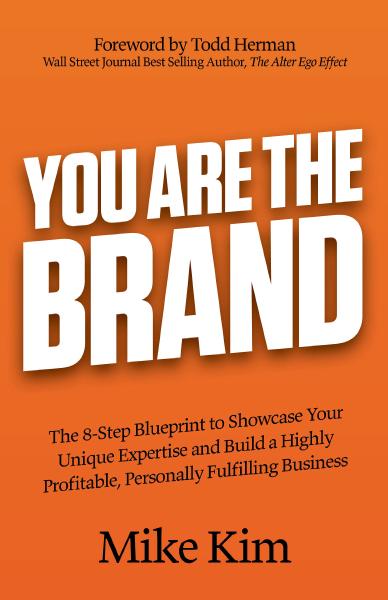
Mike Kim opens by asking himself what feeling a reader should get from his book. His answer: “Finally!” He nailed the target. This is the book I’ve been looking for on personal branding.
I picked the book up while wrestling with a familiar problem: my interests sprawl across software, sports, philosophy, coaching, writing, podcasting, leadership. Kim compares such a spread to a dance club playing five genres of music at once. No patrons will come. I still haven’t chosen my music, but at least I now have clarity: pick one, and communicate the pick clearly.
His deeper point is your brand should be integrated in yourself, not a facade constructed for others to see. Define your ideal, share the ideal, work to become the person. His litmus test for which parts of your multifaceted self belong in the brand: “Can I build a campfire around what I’m sharing?”
And the book pushes you, repeatedly, to get started. Iterative improvement only comes from doing.
His pivot story struck a cord with me. He listed what he did well in his old life, teaching high schoolers, speaking at church, marketing albums he recorded, then stripped away the specifics and kept the underlying skills: teaching, speaking, marketing. Ready to apply in a new domain.
He also hires coaches for everything he wants to improve at. With my sports background this should be the obvious approach for me, yet I don’t do the same. Something to rectify in the coming months.
The mental models earn their place. Pebbles and big stones: small daily content builds your audience, big marketing drives convert prospects into customers. His funnel twist moves people from Unaware to Aware through stories, then secrets, then your specific solution, and ties neatly into email nurturing. His “Sadistic Selfies”, photos taken to remember the pain of a situation he wanted to escape, reminded me of David Goggins’ mirror photo and the advice in Switch to make pain visceral.
Not everything landed. The split between “how-to-preneurs” and “ideapreneurs” felt off to me. These are two approaches to the same goal, most of us mix both, and you need both anyway.
The book also runs rampant with woo-woo. Kim lauds how finding his enneagram type helped him understand himself, and tells of helping a woman push her radio-wave hypochondria on customers. None of this diminishes the useful parts, but a sour taste lingers.
The product chapters fixate on his own narrow path, speaking and writing and coaching, then productizing, all B2C. I would skip the last three chapters entirely and read Hormozi’s $100M Offers and $100M Leads instead, then go deeper with The Mom Test, The Pricing Roadmap, and Building a StoryBrand.
Still, Kim leads by example throughout, sharing his own stories, and the book broke through mental blocks I’d carried for a while. If you’ve been circling personal branding without starting, this is where to begin.
→ Get You Are The Brand now!ad
My highlights
I did what I usually do when I feel lost—I read a lot of books. Books have changed my life.
What I was really looking for was a blueprint that would combine the personal development piece (who I am), the business development piece (what I have to offer), and the marketing piece (the art and skills to persuade someone to take action).
[T]he book that had the most impact was an old, classic marketing book, Ogilvy on Advertising.
Michael Hyatt, Ray Edwards, Amy Porterfield, and Pat Flynn, […] were able to build their businesses around their ideas, expertise, reputation, and personalities. The blend of all these things made each of them unique and unable to be copied. What they had to offer was unique to each of them.
It’s easy to think, “Great! Once I have this all figured out, I’ll start.” Nope. I’m going to ask you to start and figure it out as you go, with me alongside you as your guide. You may find yourself referring back to this book weeks, months, or even years from now—and I encourage you to do so.
No builder looks at a blueprint just once and then builds the entire skyscraper. No, the blueprint is there to keep construction on track over the course of the entire project. My hope is that you will use this book in the same fashion.
[B]randing is simply about identity. Personal branding simply expands branding to include a person’s ideas, expertise, reputation, and personality. We intentionally craft a public identity for an express purpose.
Here’s a simple question that can serve as a litmus test for you: “Can I build a campfire around what I’m sharing?” By this, I mean, is there warmth? Are you building something that is attractive and inviting to others? Can you build a community around it? Are you someone whom others want to invite onto their stages, in front of their employees, or into their lives?
Don’t build your brand; become your brand. Do the hard work required to become the person you’re trying to sell to people. Embrace integrity. There is no shortcut.
I asked myself an innocent question that would forever change the course of my life: “If all goes well, do I want this guy’s life in fifteen years?” The answer was a resounding no.
It wasn’t until I met someone who was at the top of the mountain I was climbing that I realized: I was climbing the wrong mountain!
Reinventing yourself is just as much about changing the story you tell yourself as it is in changing the story you tell the public.
If you’re going to be your own worst critic, you also have to learn how to be your own biggest fan.
You can’t move on to the next chapter if you keep rereading the last one.
It’s likely that you are going to fall under one of the three broad areas of health, wealth, or relationships. […] People want to get paid, get laid, or live forever.
I know that narrowing your focus can feel unsettling, like you’re making a lifelong commitment to a particular market. I assure you that it’s always possible to pivot later.
[A]t some point it will be important for you to put your expertise into some kind of format (recorded video, audio, book, blog, etc.) so people can interact with your content in privacy—or as I like to say: at their own pace and in their own space.
Eventually, I wised up and zeroed in on one vertical focus: business thought leaders. My horizontal focus involved two things: brand strategy (I would advise them on marketing campaigns) or product launch copywriting (writing high-converting sales pages, ads, and other direct-response collateral).
In the Valley of Focus, you whittle down all of your random ideas to focus on one idea, topic, or market. You decide whether you will specialize in health, wealth, or relationships. You narrow your focus even further to determine what you will do in your particular market. It hurts because you are multi-passionate, but you also start to understand, much like a dance club, that you cannot play five different types of music and expect to attract patrons to your establishment.
Have you ever noticed how people rarely say “no” on your behalf when it comes to doing more work? This became an injustice to me, and I was insanely motivated to build my business and never let anyone control when I was allowed to spend time with my loved ones.
One of the most popular slogans of our generation is Nike’s “Just Do It.” Take that same slogan and slap it onto the front window of a donut shop or skydiving company, and you completely change the message without changing a single word. Remember, content is king, but context is the kingdom.
It’s possible to be grateful for what we have and still want something different. When you double down on gratitude at the expense of your own honesty, you really have a false gratitude that moves you out of integrity.
I was grateful for my job. I was making good money, well-respected in the company, and I learned invaluable lessons during my time there. I was also totally miserable at times.
Every time I felt lulled into settling with my job, I opened my “Sadistic Selfies” folder and gave those pics a real good look. […] I still use this tactic when I’m doing some sort of life-sucking task, like anything with technology, budgeting, or bookkeeping. It’s helped me hire the right help and stay in my lane.
Clarity comes through a marriage of movement and meditation, so we might as well get comfortable with the dance.
[I]f I could sum up everything I feel about marketing in one sentence, it would be this: Marketing isn’t about closing a sale; it’s about opening a relationship.
Here are the three personal stories I recommend you start with: The Founder Story The Business Story The Customer Story
Some folks may hear of you through your podcast. Others may have heard you speak on someone else’s podcast or at a conference. Still others may follow you via any number of social media channels or saw a video of you circulating online. A friend or colleague may have referred you. There is no shortage of places you can broadcast your message and share your story. Yet all of these roads should lead back to you and to your “home base.”
The idea of a home base was drilled into me by leadership author (and my original online mentor) Michael Hyatt while I was a member of one of his coaching programs.
I’m no expert on the Chinese zodiac, but I do know that every year is the year of a certain animal: the year of the horse, rat, and so forth. While I’m not a believer in that kind of stuff, I did like the year-by-year approach and decided to focus on developing one key area of my business per year.
I know you want to get this right and get it perfect, but the more important thing is for you to gain the reps, build the muscle of self-expression, and put yourself out into the world in new ways.
The three sub-identities of your brand are: Visual Identity, Verbal Identity, Value Identity. Each of these sub-identities are like legs on a stool. If one is “off,” then your entire brand will be unstable. If they’re aligned, then you have a clear and cohesive brand identity.
You probably don’t need as strong of a visual logo as Target or Starbucks, but your photos, fonts, and colors on your website, and even your wardrobe will play a part in your visual identity.
One of the ways to position yourself is to use the size of the big competitors against them by telling your clients you are not them.
Your personal stories will be first and foremost in making you stand out. Even if there is a competitor who teaches on the same subject matter and targets the same audience as you, there is differentiation because of who you are.
There’s no exact science to this, but I would generally say that only 20% of my posts are of a more personal nature, and 80% have to do with business or branding. That’s just the rhythm that works for me.
Your product or service should help people gain more time, make more money, or develop a new skill. Or vice-versa: You help people save time, save money, or save them from having to learn a skill (because you’re doing something for them).
There is a huge difference between why a person buys something and what they say about it afterward. Your front-end messaging is usually going to be different than the back-end feedback you will receive. […] Your job when creating and marketing a product is to create certainty by helping them articulate what they want.
All too often, our standards for clients or customers is “anyone who has money.” It’s our job as business owners to clarify the kind of client or customer we want to attract.
You cannot build your business while sitting in a luxury box at the ballpark. You may be able to impress people from a distance, but you can only impact them from up close. Get on the field and grind in the dirt with your people.
Call me crazy, but I don’t think anyone should be able to buy a block of your time or “pick your brain” (especially for free) without you having a say.
Ask any attorney if he or she likes hourly billing and chances are they hate it because the better they get, the quicker they can do the work—yet the less money they make. Unfortunately, that’s just how their industry works.
There is a simple guideline I’ve used to determine hourly rates I call the “Traffic from Hell Principle” (and remember, I’m from New Jersey). […] If you had to sit through thirty minutes of bumper-to-bumper, standstill, not-going-anywhere traffic to pick up cash and then drive back home for another thirty minutes, how much would I have to give you? $50? $100? $500? $1,000?
It’s also very important to present three options of working together: Good, Better, or Best. This gives the prospect choices. If you only present one option, you severely decrease your chances of landing any work. Remember: People love to buy; they do not like to be sold.
Keep this in front of you whenever you are writing campaigns: Unaware = Stories Problem Aware = Secrets Solution Aware = Repeat Problem / Solution Product Aware = Promises Aware = Pitch Your Offer
You must take immediate control of the call and establish the agenda. This isn’t to bully anyone; it’s to make the call more effective and ethical.
Running a successful expertise business involves more than coaching, consulting, speaking, or freelancing. It requires clear and professional client communications and an ability to properly manage the business end of your projects. Everything is branding!
Never tell a story without making a point, and never make a point without telling a story.
Write the phrase, “I never thought it was possible, but…” Complete the thought. Delete the “I never thought it was possible, but…”
I firmly believe you need to have some sort of a big push at least two to three times a year, preferably three. That way, the interim periods of time can be used to create content and nurture prospects into whatever you are promoting.
Daily posts on social media are great, but they’re more like pebbles you throw into a pond. It makes for a cool sound, but it doesn’t make waves—at least when it comes to sales. At some point, you need to pick up a big rock, throw that sucker into the water, and make a big splash!
Webinars, summits, and product launches create waves. Even if no one buys—they are, in and of themselves, publicity stunts. People take notice because you’re doing a big promotion—and the perception is that you are doing something much bigger than what your own numbers may say.
I divide the year into thirds, not quarters. I plan for three four-month blocks: January–April, May–August, and September–December.
In order to attract bigger clients, bigger stages, and more opportunities, you must build your body of work. You can’t build a reputation on what you’re going to do.
As my network has grown over the years, I’ve realized this simple principle: The good people know good people who know more good people.
One of the best ways to build rapport with others and grow your network is to host a meetup.
“The Epic Breakfast.” This is an invite-only small gathering that I usually host at breakfast during conferences I attend or am speaking at.
After the breakfast is done, see if you can snap a group photo with everyone there. Some of them may share the photo on social media, and because you were the one who made it happen, the photo will elevate your brand across your network.
It’s easy to think, “Great! Once I have this all figured out, I’ll start.” Nope. I’m going to ask you to start and figure it out as you go. The more you put yourself out there, the more you will start to discover yourself.
To most people in this world, I’m just another “character” on the internet. When someone says no to me, they’re not rejecting Mike Kim the person. […] Outside of my family and friends, humanity at large doesn’t know me in a way that should ever make me feel personally rejected. That privilege is reserved for very few people in my life, and I hope you will feel the same way about yourself as well.
Influence is currency. It’s meant to flow. The more you use it for others, the more you get. The stingiest, most small-minded people I’ve met aren’t just cheap with money—they are cheap in spirit. An abundance of money will not fix a poverty of spirit.